
Understanding the World Through Different Lenses
Exploring politics, ethics, and history beyond the headlines


Introduction
I write to speak honestly about power, even when that makes people uncomfortable. Doing this requires clarity, courage, and persistence. Throughout my life, I have chosen to engage with difficult subjects—topics many prefer to avoid. This has taught me the importance of questioning official stories, uncovering hidden interests, and keeping open, honest conversations alive.
My goal is simple: to better understand the forces that shape our world, and maybe to help others see them more clearly too.
Different Ways of Seeing the World
Today’s world is shaped by several large ways of thinking—different cultural “lenses” through which societies understand life, power, and order. Three of them are especially important:
The Sinic lens, shaped mainly by Chinese and East Asian traditions. It values long-term thinking, social harmony, and stability. Its global influence is growing quickly.
The Occidental (Western) lens, rooted in Europe and North America. It emphasizes science, individual freedom, control over nature, and economic growth. This way of thinking still dominates many institutions, but it is increasingly questioned and losing credibility.
The Indic lens, coming from South Asia. It is based on ideas like dharma (responsibility and moral balance) and ahimsa (non-violence). It is less dominant, but its influence is slowly spreading.
These ways of seeing the world do not exist in isolation. They collide and overlap in a time marked by climate change, weakening democracies, growing inequality, corporate power, and widespread distrust in institutions.
The Problem of Endless Growth
At the center of many global problems lies a shared obsession: endless economic growth. I call this industrial economism.
In this system, almost everything—technology, culture, politics, even protest—is pushed to serve profit or power. Good ideas are often absorbed, reshaped, and neutralized instead of leading to real change. As a result, societies remain trapped in cycles of exploitation, while profound issues stay unresolved.
If we want something different, we must question some very basic assumptions.
Rethinking How We Know and How We Live
First, we need to rethink how we decide what is true. In the Western tradition, numbers, data, and measurements are treated as the highest form of truth. While these are useful, they are not enough. Other traditions remind us that experience, relationships, intuition, and lived reality also matter.
Second, we need to rethink what we believe reality is. Modern Western thinking treats nature as a resource, humans as separate from it, and growth as the ultimate goal. Many Indigenous and Eastern traditions see things differently: humans, land, animals, and ecosystems are connected and depend on one another. Ignoring this has led to environmental destruction and social breakdown.
The Middle East as a Mirror
The Israeli–Palestinian conflict is typically presented as a local or religious dispute. In reality, it reflects much deeper global tensions. It shows what happens when different worldviews clash inside a system driven by power, fear, and economic interests.
This conflict is not just about two sides. It is a mirror of wider problems in the world system.
What This Looks Like in Practice
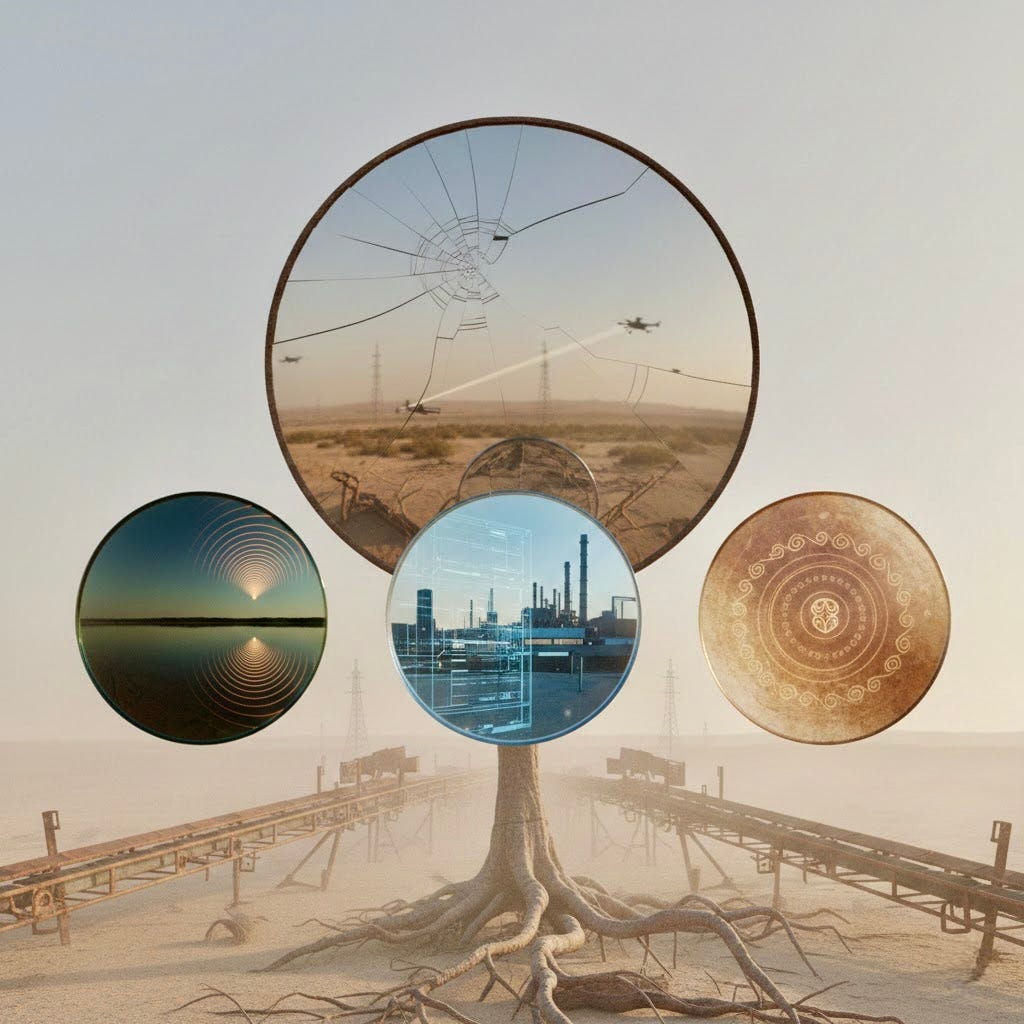
Beyond news headlines
The Hamas attack on 7 October 2023 did not come out of nowhere. It was the result of long-standing oppression, repeated violence, and a cycle in which each act of force justifies the next.
Clashing ways of thinking
Western narratives often reduce the conflict to “good versus evil.” This hides complexity and silences other perspectives. For many Palestinians, land is not just property—it is identity, memory, and survival. Ignoring this makes understanding impossible.
Technology as control
Advanced surveillance systems and AI tools—often developed by Western tech companies—are used to monitor and control populations in Gaza. Technology that could serve humanity instead strengthens systems of domination.
The role of the environment
Water shortages and desertification are not side issues. They increase tension and instability. Treating nature only as something to exploit makes both ecological and political crises worse.
Young generations pushing back
Across the region, young people protest against corruption, violence, and hopelessness. Their movements are fragile, but they point to the possibility of a different future.
The trap of economic peace
Agreements like the Abraham Accords promise that trade and investment will bring peace. In practice, they increase inequality—wealth for a few, insecurity for many.
Signs of other possibilities
Practices like sumud (steadfastness), interest-free Islamic finance, or self-organized communities such as Rojava show that alternatives to endless growth and domination are possible.
The Broader Lesson
The Middle East is both a warning and an invitation.
It is a warning of what happens when powerful worldviews collide inside a system obsessed with control and growth.
It is also an invitation to imagine different ways of living—based on cooperation, fairness, and respect for both people and nature.
Lasting peace will not come from technical fixes or economic deals alone. It requires deeper change: questioning our assumptions, listening to different voices, and accepting that there is more than one valid way to understand the world.
Only then can we begin to build societies that are more just, more stable, and more human.
Short Legend
Worldview: a shared way a culture understands life and reality
Industrial economism: a system focused on endless economic growth
Sumud: Arabic for steadfastness—staying rooted despite pressure
Source of inspiration:
Richard David Hames, Breaking Through the Source Code

More on ethics and world order 👇