

The World’s Conflicts Are Not Separate (Video at the bottom)
An Analytical Review of Geopolitical Flashpoints and Systemic Risks

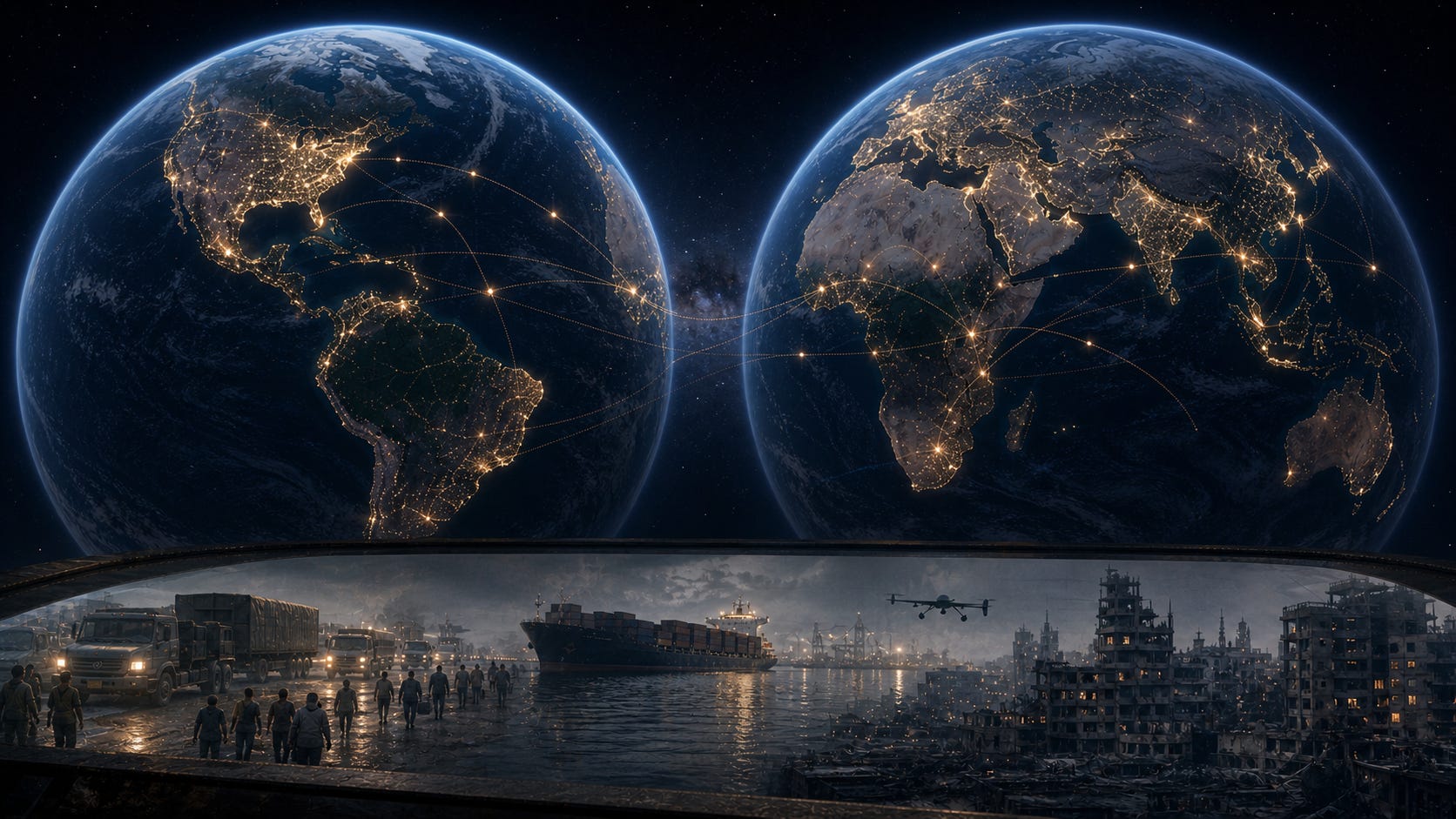
In 2025, I listed the world’s major conflicts and asked what lay beneath them. The 2026 picture is clearer, and more disturbing: these wars are increasingly connected. Territory, identity and old grievances still matter, but so do shipping lanes, minerals, energy, technology and the attention of great powers.
A ceasefire can stop the shooting for a while. It cannot by itself settle who governs, which borders count, or whose security comes first. That is the thread running through this update.
The conflict map
The map below is not a ranking of human suffering. It is a guide to the main drivers and the outside powers that connect each theatre to the wider system.
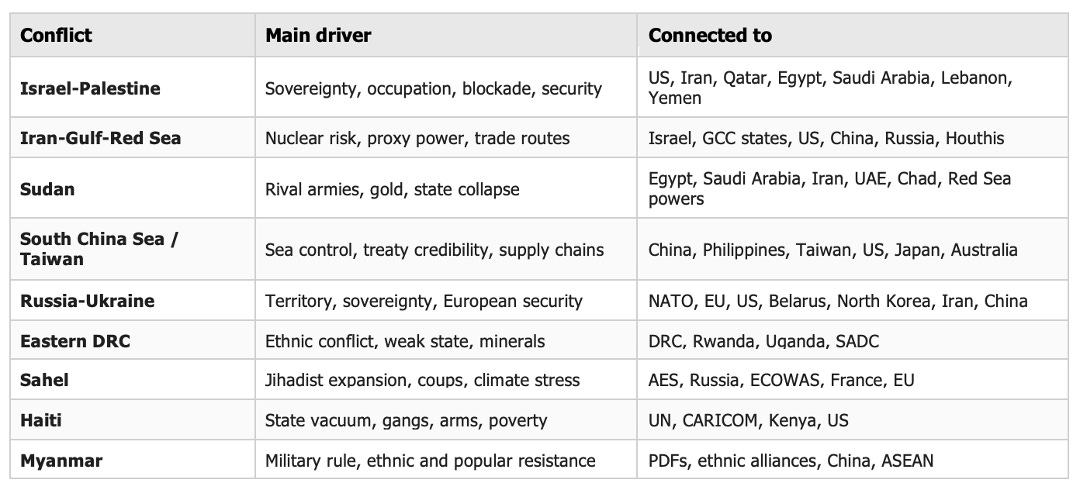
• Gaza, Israel and the West Bank
Core origin: The conflict grows from Palestinian displacement after 1948, Israel’s occupation after 1967, the Gaza blockade since 2007, competing claims to sovereignty, and the refusal of both sides to accept the other’s security and political demands.
What changed: After the Hamas attacks of 7 October 2023 and Israel’s military campaign in Gaza, the research records more than 70,000 Palestinian deaths, famine conditions and a collapse of civilian infrastructure. A US-backed ceasefire took effect on 10 October 2025 under UN Security Council Resolution 2803. Surviving hostages were returned, but the second phase stalled.
Israel demands that Hamas disarm before a full withdrawal. Hamas rejects that condition while Israeli forces remain across roughly 58 per cent of Gaza. Fighting and strikes have continued around the security perimeter, while aid and reconstruction remain far below what the agreement intended.
Pressure has also shifted to the West Bank. The research describes faster settlement expansion, more land seizures and military operations that displaced more than 32,000 people from northern refugee camps. This further weakens the Palestinian Authority and makes a two-state settlement harder.
Connected to: The United States monitors the ceasefire and supports aid coordination; the research says about 200 US personnel were sent to Israel in late 2025, though not into Gaza. Qatar and Egypt remain mediators. Jordan and Saudi Arabia warn about further escalation, while Iran-linked groups in Lebanon, Yemen and Iraq keep the conflict tied to the wider region.
Risk: A divided Gaza with weak civilian rule, combined with deeper West Bank fragmentation, may turn a formal ceasefire into a long period of armed containment rather than peace.
• Iran, the Gulf states and the Red Sea
Core origin: Since Iran’s 1979 revolution, Tehran, Israel and the Arab Gulf states have competed over regional power, ideology and security. Iran relies on allied armed groups to deter attacks and extend its reach.
What changed: China-backed talks lowered the immediate risk of direct fighting between Iran and the Gulf monarchies, but they did not remove the rivalry. Houthi attacks and interceptions around the Red Sea and Bab el-Mandeb show how a local force can disrupt a global trade route.
Saudi Arabia and the United Arab Emirates want stable shipping, investment and energy exports. They have resisted using their territory for attacks on Iran, yet they continue to strengthen intelligence links and air and missile defence with the United States.
Connected to: Gaza, Hezbollah in Lebanon, the Houthis in Yemen, Iraqi militias, US forces, Israel, China and Russia. The same network connects nuclear risk, oil markets and commercial shipping.
Risk: An Israeli strike on Iran’s nuclear programme, or a proxy attack that causes mass casualties, could close energy routes through the Persian Gulf or Red Sea and overwhelm today’s cautious détente.
• Sudan: a state splitting in two
Core origin: Sudan’s war began in April 2023 as a power struggle between the Sudanese Armed Forces (SAF) and the Rapid Support Forces (RSF). Behind it lie decades of military patronage, Darfur’s unresolved violence, regional neglect and rival security forces built under the Bashir dictatorship.
What changed: The war has become a de facto partition. The SAF holds much of the north, east, Nile corridor and Red Sea coast, with Port Sudan as the recognised government’s base. The RSF dominates much of Darfur and parts of Kordofan, where it runs parallel systems of taxation and control.
Gold and smuggling networks help finance the RSF. The SAF relies on formal state revenue and outside military support. The research reports famine, collapsed farming and more than ten million internally displaced people. It also describes ethnic cleansing against non-Arab communities in Darfur.
Connected to: Egypt, Saudi Arabia, Turkey and Iran support or supply the SAF; RSF supply networks run through the UAE, Chad and regional mercenary channels. Iran’s reported drone support and interest in Red Sea access add another layer of competition around global shipping.
Risk: If both sides keep their own territory and income, Sudan may harden into a Libya-style division while weapons and fighters spread into Chad, the Central African Republic, South Sudan and Libya.
• South China Sea and Taiwan
Core origin: The South China Sea combines disputed maritime claims, national pride, fishing and energy rights, and control of sea lanes. Taiwan’s division dates to the Chinese Civil War in 1949 and now also involves democracy, national identity and the island’s central place in advanced chip production.
What changed: China increasingly uses coast guard and maritime militia vessels to change facts at sea without starting a declared war. The research says the South China Sea carries about $3.4 trillion in annual trade, roughly one-third of global maritime commerce.
Around Scarborough Shoal, Chinese coast guard presence rose to 1,099 ship-days in one year, with a floating barrier used to restrict Philippine fishermen. At Sabina Shoal, deployments reached 405 ship-days. In March 2026, a Chinese corvette aimed fire-control radar at a Philippine frigate - a dangerous step because radar locking can be read as preparation to fire.
Around Taiwan, China has made encirclement and quarantine exercises more routine. The research records an average of 319 Chinese military aircraft incursions into Taiwan’s air-defence identification zone per month, 129 per cent above the earlier level. Exercises increasingly rehearse inspections or blockades of commercial shipping, not only an invasion.
Connected to: The Philippines is protected by a 1951 defence treaty with the United States and is expanding patrols with the US, Australia and Japan. A quarantine of Taiwan could disrupt semiconductors, container traffic and liquefied natural gas. China also benefits when wars in Europe and the Middle East consume Western weapons and political attention.
Risk: A fatal collision, ramming or radar incident could force Manila and Washington to decide whether coercion below the level of open war has crossed a treaty line. Around Taiwan, a selective quarantine could cause global economic damage without offering a simple military response.
• Russia and Ukraine
Core origin: The war grows from the Soviet collapse, Russia’s 2014 annexation of Crimea and war in Donbas, competing views of Ukraine’s sovereignty, and the collapse of Europe’s post-Cold War security order.
What changed: The war is now a long contest of manpower, industry, drones and missiles. The research estimates that Russia gained about 0.4 per cent of Ukraine’s total territory over twelve months despite heavy losses. Negotiations in Istanbul, Geneva and Abu Dhabi did not bridge the basic divide.
Russia demands recognition of Crimea, Ukrainian withdrawal from all of Donetsk, Luhansk, Kherson and Zaporizhzhia, permanent neutrality and strict limits on Ukraine’s military. Ukraine and its European partners reject these terms as surrender and seek binding security guarantees.
Russia continues large drone and missile attacks on Ukraine’s power, gas and urban infrastructure. Ukraine uses long-range drones against Russian refineries, depots and command sites. Slow movement on the ground has shifted more of the pressure onto economies and civilians.
Connected to: NATO, the European Union and the United States support Ukraine; Belarus, North Korea and Iran support Russia in different ways, while China benefits strategically from Western distraction. European governments are preparing for more independent defence planning as US priorities shift.
Risk: Even a frozen front may leave a continuing cyber, sabotage and political conflict along NATO’s eastern edge. A pause without credible security terms could become time for rearmament.
• Eastern Democratic Republic of Congo
Core origin: The conflict carries the legacy of the 1994 Rwandan genocide, refugee militarisation, ethnic fear and weak government control in mineral-rich eastern Congo.
Current picture: The Tutsi-aligned M23 movement retains territory in North Kivu despite repeated ceasefires and regional peace efforts. Fighting is sustained by competition over coltan and gold, local insecurity and proxy support.
Connected to: Rwanda, Uganda, the Congolese state and the Southern African Development Community. Minerals from the region also enter wider global supply chains.
• The Sahel
Core origin: Mali, Burkina Faso and Niger combine weak post-colonial states, ethnic exclusion, Tuareg rebellions, climate pressure and growing jihadist movements.
Current picture: Military governments have consolidated power, removed many Western security forces and formed the Alliance of Sahel States. JNIM and Islamic State-linked groups have expanded rural corridors under their influence.
Connected to: Russia’s Africa Corps and former Wagner networks, ECOWAS, France and the European Union.
• Haiti
Core origin: Decades of institutional weakness deepened after President Jovenel Moïse was assassinated in 2021. Armed groups filled the political and security vacuum.
Current picture: Gang federations control large urban areas, while the state struggles to provide basic administration or security. Displacement and economic collapse continue despite fragmented international deployments.
Connected to: The United Nations, CARICOM, the Kenyan-led Multinational Security Support Mission and the United States, as well as illicit firearms networks.
• Myanmar
Core origin: Myanmar never settled how a multi-ethnic state should share power after independence. The 2021 coup ended the civilian transition and widened the conflict.
Current picture: People’s Defence Forces and ethnic armed organisations coordinate against the junta. The military has lost peripheral territory and important trade routes, while resistance has also moved into cities.
Connected to: China, ASEAN, border trade and regional refugee flows.
What connects these conflicts
• Limited attention and weapons. The United States and Europe must divide air defence, ships, ammunition and diplomatic focus among Ukraine, the Middle East and the Indo-Pacific. Rivals can test the gaps.
• Parallel war economies. Gold, discounted oil, smuggling and informal arms routes help sanctioned governments and armed groups survive outside Western-led financial systems.
• Pressure below the level of war. Cyberattacks, maritime militias, drones, proxies and economic coercion make aggression harder to define and therefore harder to answer.
• Ceasefires without settlement. If an agreement leaves sovereignty, government, borders and local legitimacy unresolved, it may pause violence without ending the conflict.

Reflection
I keep returning to an uncomfortable thought: we are modern in our tools, but not always in our instincts. We use satellites, drones, cyberattacks and financial sanctions to replay old struggles over land, security, identity and status.
These conflicts are not simply religious or tribal. History matters: colonial borders, genocide, occupation, state collapse and old rivalries remain present. But leaders also make choices. They choose whether memory becomes a reason for coexistence or a weapon for the next round.
Deterrence may buy time; it cannot decide what the time is for. A durable peace needs security, but also legitimate government, workable borders, access to resources and some recognition of the other side’s future. Without that, a treaty can become a stage set: impressive from a distance, hollow behind the façade.
My conclusion is therefore not optimistic, but neither is it fatalistic. Human beings inherit conflicts, yet we also rewrite institutions. The real test is whether governments use a ceasefire to prepare for peace - or merely to prepare for the next war.
Robert F. Tjón, mid-August 2026
AI disclosure: I use artificial intelligence for creating visuals, and for data synthesis & structural mapping. AI-generated insights may contain inaccuracies; readers should verify critical information independently. All conclusions and final editorial decisions remain the original work of Robert F. Tjón.
This content is licensed under Creative Commons Attribution-NonCommercial-NoDerivatives 4.0 International.
The Video:
For a more detailed analysis:
Abbreviations
In the text
AES Alliance of Sahel States
AI Artificial intelligence
ASEAN Association of Southeast Asian Nations
CARICOM Caribbean Community
CC BY-NC-ND 4.0
Creative Commons Attribution–NonCommercial–NoDerivatives 4.0 International
DRC Democratic Republic of the Congo
ECOWAS Economic Community of West African States
EU European Union
GCC Gulf Cooperation Council
JNIM Group for the Support of Islam and Muslims
M23 23 March Movement
NATO North Atlantic Treaty Organization
PDFs People’s Defence Forces
RSF Rapid Support Forces
SADC Southern African Development Community
SAF Sudanese Armed Forces
UAE United Arab Emirates
UN United Nations
US United States
In the References
CES part of the name “CES Intelligence”; not expanded in the document
FM Foreign Minister
GOV.UK United Kingdom government website
UTS University of Technology Sydney
Sources & references
Conflicts Across the Globe 2025
Russia-Ukraine War in 2026: At the Crossroads of Peace and War - Observer Research Foundation
Israel-Hamas War (Gaza Conflict) - Encyclopaedia Britannica
Israel and the Occupied Palestinian Territory - Global Centre for the Responsibility to Protect
Israeli-Palestinian Conflict - Council on Foreign Relations Global Conflict Tracker
Nine Months In: Assessing the Status of the Gaza Ceasefire - J Street
From Gaza to Gulf, Peace in Middle East Hinges on Resolving Israel-Palestinian Conflict - UN Press
Sudan 2026: Geopolitical Risk Assessment - CES Intelligence
Millions of US tax dollars sent to rightwing European thinktanks - The Guardian
The South China Sea in 2025: More of the same, possibly worse - ThinkChina
The Philippines, Australia and the South China Sea contest - UTS
Philippines’ Persistent South China Sea Challenge as 2026 ASEAN Chair - Universitas Airlangga
South China Sea Tensions: China Coast Guard vs Philippines - AcademicJobs
Tracking China’s Increased Military Activities in the Indo-Pacific in 2025 - ChinaPower Project
Peace negotiations in the Russo-Ukrainian war (2022-present) - Wikipedia
Think Tank reports on Russia’s war of aggression against Ukraine - Council of the EU
The Russia-Ukraine War Report Card, Aug. 12, 2026 - Russia Matters
Country bulletin: security situation in Gaza, Palestine, June 2026 - GOV.UK
World Report 2026: Israel and Palestine - Human Rights Watch
Rubio arrives in Manila as China-Philippines tensions spike - Responsible Statecraft
Russian Offensive Campaign Assessment, May 25, 2026 - Institute for the Study of War
Russian FM Lavrov threatens tougher tactics, signals war will continue - The New Voice of Ukraine


What becomes especially clear in this mapping is that war no longer remains where it is fought. Its consequences travel through shipping routes, energy markets, food prices, public budgets and the ordinary household long before many people understand why their lives have become more precarious. The battlefield is only the most visible part of the conflict; beneath it lies an interconnected system in which military pressure, economic coercion and political distraction continually reinforce one another.
Your point about ceasefires is crucial. Stopping the weapons without resolving sovereignty, legitimacy, security and access to resources may interrupt death, but it does not yet create peace. It merely changes the form in which the conflict waits.