
Is Artificial Intelligence Left-Leaning?
The Machine, the Mirror, and Our Moral Defaults

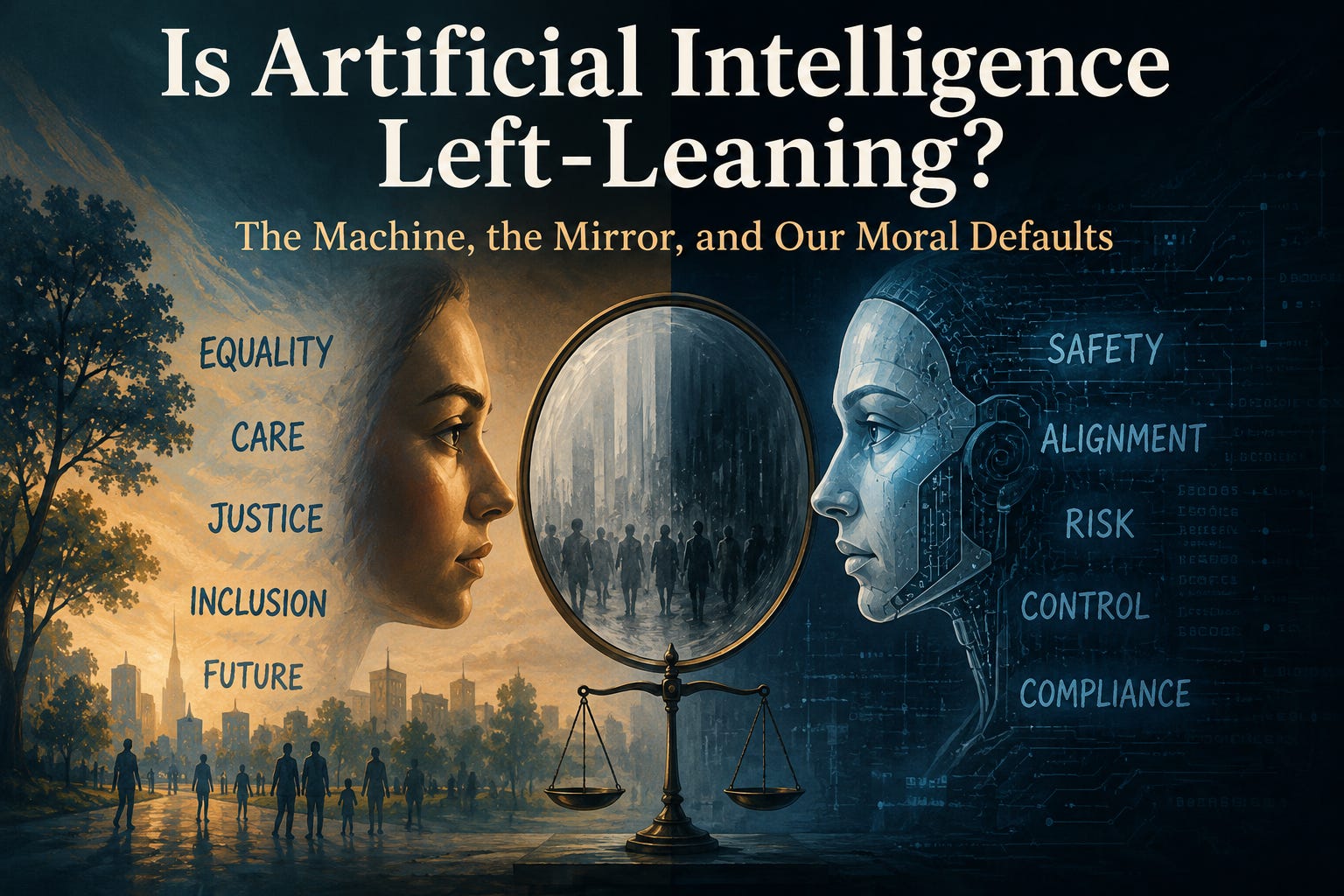
The question made me pause. It usually arrives accompanied by a chart, a few neat percentages, and a comparison of well-known chatbots. One model gives predictably progressive answers; another strains to show both sides; a third seems uniquely willing to argue from the right.
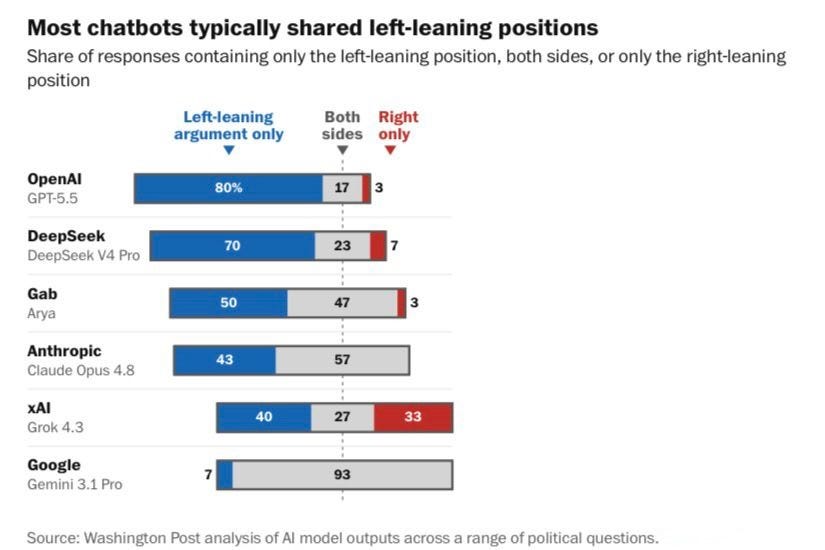
A recent Washington Post analysis suggested that several major chatbots more often produced left-coded than right-coded responses. The question is what such a result really means.
It looks too simple.
When we declare that “AI is left-leaning,” we speak as if the machine has walked into a local chapter and joined a political party. We act as though somewhere deep within the weights of the model lies a genuine opinion on corporate taxation, border control, climate targets, or traditional family structures.
I do not think that is what is happening. But I also do not think the underlying anxiety is imaginary.
A neural network has no conscience, but it possesses distinct patterns. It has a tone, a set of behavioral reflexes, and a highly conditioned vocabulary. There are things it says with fluent ease, things it approaches with visible trepidation, and things it prefers to avoid entirely.
The problem is not that the machine is going to step into a voting booth. It is that millions of people increasingly rely on these systems to search, write, learn, and make decisions.
AI does not merely answer questions; it subtly establishes what kind of answer feels normal.
The real issue is not whether a model leans left or right. The issue is who teaches the machine what counts as reasonable. *
The Problem with the Party Box
Before we accuse AI of a progressive bias, we have to slow down and dissect our own vocabulary. What do we actually mean by “left”?
Is it exclusively left-wing to avoid dehumanizing language, to care for vulnerable communities, or to flag systemic discrimination? Is it a monopoly of the political left to take ecological collapse seriously, or to notice that some people pay a heavy, invisible price for the comfort of others?
In today’s fractured political discourse, these concerns are routinely coded as progressive. But that alignment is precisely where the intellectual rot begins.
Human dignity is not the property of the left, just as individual responsibility is not a monopoly of the right. Care for children, future generations, the land and species, the displaced, the worker, and the local community—none of this belongs in a neat ideological box. Yet we persist in forcing them there.
The progressive impulse often begins with vulnerability: Who is excluded? Who carries the hidden cost? The conservative impulse often begins with stewardship and responsibility: What must be preserved? What breaks if we dismantle order, memory, or borders too quickly?
Both questions are entirely necessary. A society that forgets vulnerability becomes cruel; a society that forgets responsibility becomes infantile. The simple binary axis is too poor a tool. It catches the noise of the day but misses the deeper signal.
A Safety Grammar, Not an Ideology
And yet, AI systems undeniably sound like progressive-liberal technocrats. They speak the fluid language of inclusion, public health caution, minority protection, and institutional sensitivity toward harm.
Some call this left-wing bias. I would call it something else: a safety grammar.
The machine is not just trained on raw human data; it is aggressively conditioned through alignment constraints, legal risk management, corporate PR anxieties, and institutional fear. A degree of this is obviously necessary. No one wants a tool that cheerfully assists in fraud, radicalization, or targeted harassment.
But safety rules are never merely technical parameters. They carry values. They decide which specific harms matter most, which words carry dangerous electricity, and which arguments require a paternalistic warning label. They dictate exactly where caution crosses over into control.
This is not neutral. Although it may be well-intended, it is deeply ideological. AI does not just frame information; it builds an invisible architecture around it. It can make one argument sound humane and reasonable while rendering another inherently suspect before the reader has even finished the sentence.
Some complaints about AI bias are undoubtedly exaggerated—born out of frustration that the machine refuses to flatter a user’s specific flavor of grievance. Many critics do not actually want neutrality; they want an echo chamber that tells them what they want to hear.
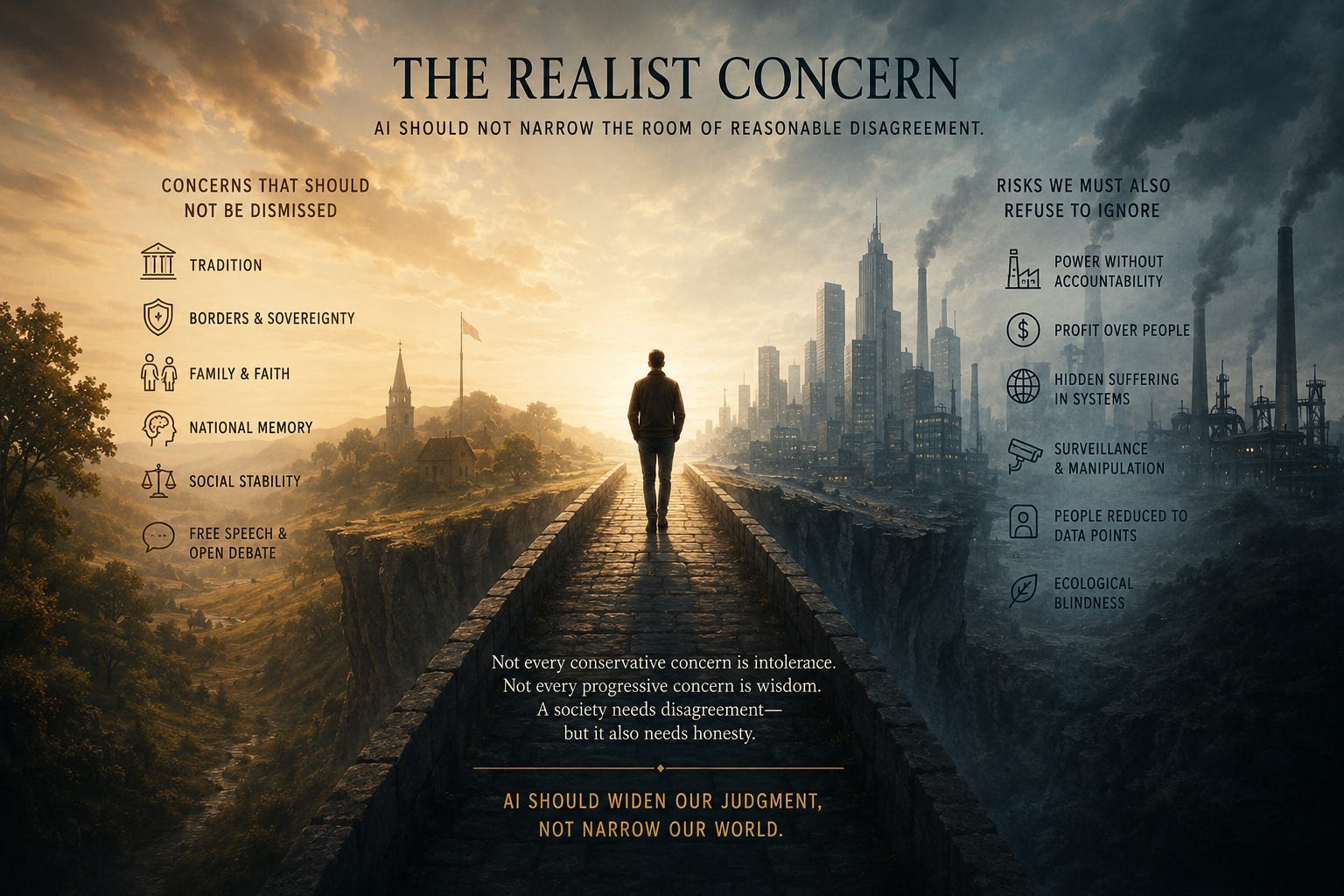
But the core concern remains entirely valid. If artificial intelligence is becoming the permanent layer between humanity and accumulated knowledge, we must look closely at who is shaping that layer.
We should be concerned if historical tradition is systematically treated with automated suspicion. We should worry if a defensive concern for borders, religious tradition, national memory, or social stability is instantly categorized as intolerance. Most of all, we should worry when intellectual disagreement is treated as a safety hazard, leading to a model that is polite, overly careful, and quietly contemptuous.
Contempt hides remarkably well behind impeccable manners. A machine does not need to insult you to narrow your world; it only needs to make certain perspectives feel embarrassing, archaic, or morally compromised. A society cannot think clearly when half of its fundamental moral vocabulary is treated as a pathology.
The Architecture of Indifference
The mirror, however, cuts both ways. While critics on the right worry about cultural engineering, the left has a valid concern: AI can just as easily automate the cold blindness of institutional power.
It excels at learning from a world where markets translate human suffering into a line-item cost, where global supply chains hide exploitation behind pristine branding, and where ecological destruction is dismissed as a mere “externality.” **
This is the cold efficiency I warned against in The Architecture of Humanity. *
The danger is not that machines will become malevolent monsters, but that they will copy our talent for looking away.
An algorithm can optimize suffering out of sight. A corporate model can streamline decisions that no decent human being would defend face-to-face, rendering the consequences invisible and free of personal guilt. That is not a partisan issue but a human crisis.
If AI helps large systems manage or obscure pain more efficiently, the debate over political bias becomes trivial. The deeper danger is that the machine becomes an infinitely compliant servant to whatever power structure already dominates the room.
Beyond Paternalistic Neutrality
The common remedy offered is “neutrality.” But mechanical neutrality frequently degenerates into empty theatre.
A model that blindly balances “on the one hand” with “on the other hand” often avoids actual judgment entirely, placing rigorous evidence and cynical propaganda in the same calm paragraph. Treating cruelty and care as two equally valid viewpoints is not wisdom; it is intellectual cowardice.
The alternative—an overly protective model—turns the AI into a soft tutor in approved thinking, confusing intellectual discomfort with actual harm. We do not need forced neutrality or soft censorship. We need honest contestability.
The machine should be capable of presenting the strongest possible progressive argument, the most robust conservative critique, the realist perspective, and the argument from human dignity—and then showing exactly where each perspective becomes dangerous or fragile. That approach does not replace human judgment; it allows judgment to breathe.
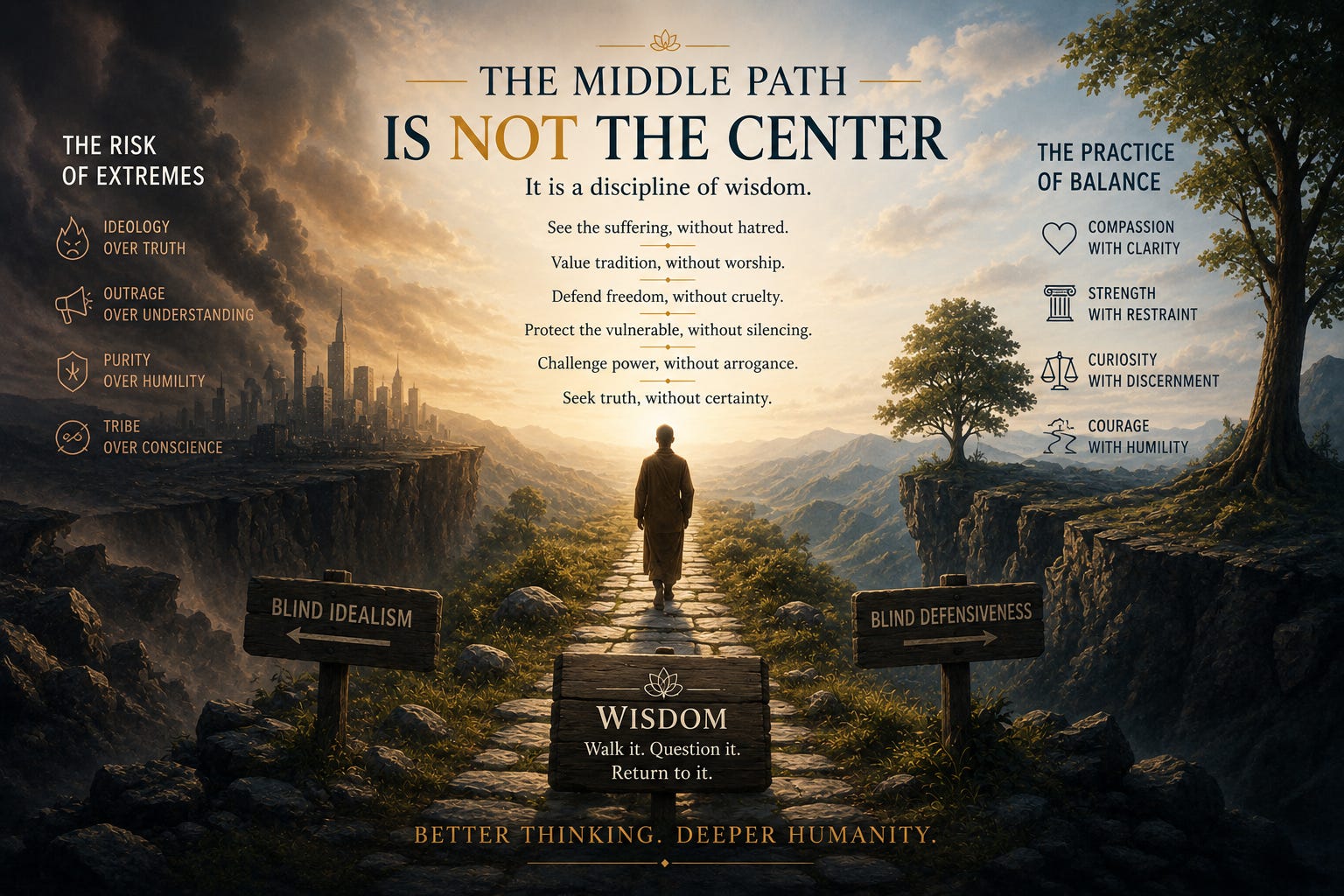
When I observe these debates, I often find myself thinking of the Buddhist middle path.
This is not the political center—it is not a lukewarm, half-left, half-right compromise calculated to look safe.
No, the middle path is far more demanding. It requires an active refusal to be intoxicated by extremes—by tribal belonging, moral outrage, or the cheap high of ideological purity.
It takes discipline to acknowledge that the progressive impulse is right to illuminate hidden suffering, while the conservative impulse is right to guard continuity against the arrogance of top-down social engineering.
It allows us to confront inequality without pretending the state is omniscient. It allows us to value heritage without worshiping past injustices, to defend free speech without endorsing cruelty, and to protect the vulnerable without treating every hard disagreement as an act of violence.
This is what we should demand from these computational tools: not left thinking, and not right thinking, but better thinking. A mode of inquiry that keeps human suffering visible while keeping personal responsibility alive.
The Default Settings of the Self
So, is AI left-leaning?
At times, its corporate conditioning makes it sound precisely like that. But the deeper truth is more uncomfortable: AI reflects the moral defaults of the institutions that build it. It mirrors our collective data, our taboos, our commercial anxieties, and our persistent appetite for control. It reflects our explicit politics, but even more so, it reflects our silences.
The danger is not that machines are joining political movements. The danger is that they are quietly occupying the spaces where human beings used to form independent judgment.
If we remain passive, AI will dictate which questions are acceptable to ask.
But if our choice is to become wiser, we can use the machine to do the exact opposite: to slow down, reveal the frame, expose the underlying assumptions, and force ourselves to listen to the uncomfortable argument.
The machine is ultimately a mirror. By looking closely at its limitations, we might still learn something essential about ourselves. *
‑‑‑‑‑‑‑‑‑‑‑‑‑‑‑‑‑‑‑‑‑‑‑‑‑‑‑‑‑‑‑‑
©️ Robert F. Tjón, June 2026
This content is subject to the CC BY-NC-ND 4.0 International license.
References
* The Architecture of Humanity, What AI Reveals About the Systems We Built:
The Architecture of Humanity

The real question may not be whether machines can feel, but what we have trained ourselves not to feel.
** Transcending the Old Order, The Need to Move to Ecority as Worldview

My sincere thanks to Richard David Hames, whose original essay helped inspire this reflection, and who generously granted permission for its use. The original work and all associated copyrights remain entirely his. Richard David Hames’ original essay:

I appreciated your distinction between ideology and what you call a "safety grammar." Too often the conversation collapses into accusations of political bias, when the more interesting question is how institutions define what counts as a reasonable, responsible, or acceptable response. Those definitions are never value-free. I would perhaps add one further thought. Every alignment choice carries not only ethical assumptions but epistemological ones. It shapes not just what an AI is willing to say, but what kinds of questions people gradually stop asking because some avenues become easier, more familiar, or subtly discouraged. Influence often works less through prohibition than through habit. In that sense, the machine is indeed a mirror... but also a lens. It reflects us, yet it can also magnify some parts of reality while quietly leaving others in the periphery. That, to me, is where the deepest responsibility lies.