
Greenland | Security? Minerals? Or AI-Data Centers?
A junction where three forces collide: what it's REALLY about

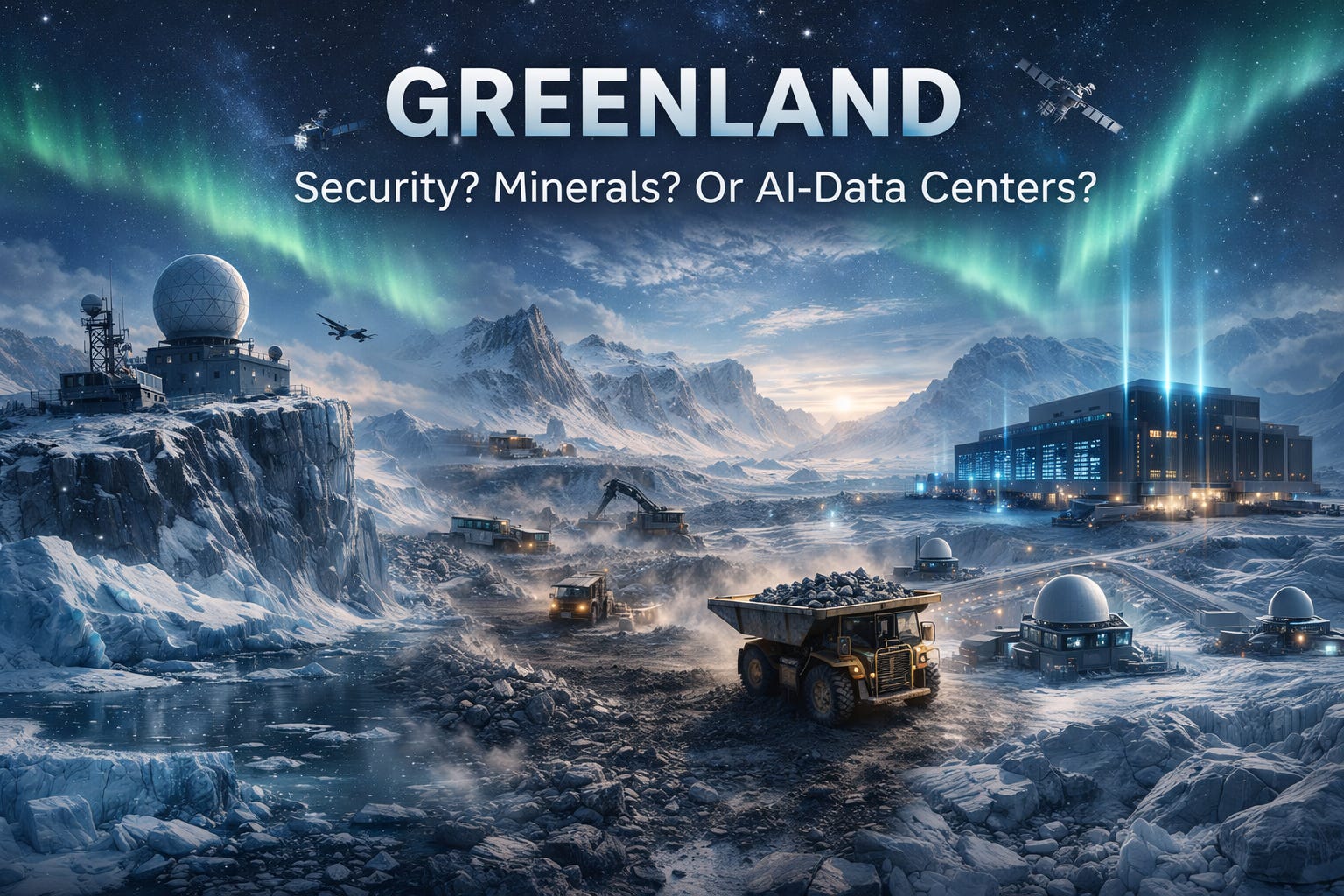
Greenland looks empty on a map.
A white mass. A few coastal towns. A vast interior of ice. For most of modern history, it has been the kind of place that powerful capitals could ignore—until they suddenly did not.
And when great powers suddenly “discover” an empty place, it is rarely because they fell in love with the silence. So here is the Greenland question, stated plainly:
Is Greenland being pulled into the spotlight for security—because it is truly a shield?
Or for minerals—because modern technology eats rock?
Or for AI-data centers—because the new “territory” is compute, and compute needs cold, power, and control?
The honest answer is not “one of the three.” It is that Greenland has become a junction: where military legacy, resource hunger, climate change, and digital sovereignty collide. And when collisions happen, someone always pays the hidden costs.
1) Greenland as a question
If you listen to the public narrative, Greenland is “about defense.” That line feels clean., almost respectable. It sounds like NATO, radar, deterrence, and responsibility.
But Greenland also sits on the fault line of three deeper shifts:
The Arctic is opening (sea lanes, access, leverage).
The resource map is rewriting geopolitics (rare earths, graphite, strategic projects).
And the digital economy is turning cold places into strategic infrastructure (“free cooling,” data sovereignty, dual-use ground stations).
So the Greenland question is also a moral question:
When the world’s big systems change, who decides what “strategic” means, and who carries the consequences?
2) A short history of Greenland’s territory (why “buying it” is legally absurd)
To understand why Greenland is not a poker chip, you need the long timeline, not the headline. Greenland’s link to Scandinavian crowns is over a thousand years old—beginning with Norse arrival and later formal submission to the Norwegian king, then inherited through the Danish-Norwegian union.
Modern legal milestones matter more:
1814 (Treaty of Kiel): Greenland stays with Denmark.
1933: Denmark’s sovereignty claim is upheld in international adjudication (PCIJ) after dispute with Norway.
1951: The U.S.–Denmark defense agreement formalizes U.S. military rights; this is the Cold War hinge.
1953: Greenland stops being treated as a “colony” and becomes integrated as a regular part of the Danish realm, with Greenlanders as citizens—with consent of Greenland’s Provincial Council.
1979 Home Rule → 2009 Self-Determination: the key conceptual shift: from “land” to “people.” Greenlanders are recognized as a people with a right to self-determination, including independence.
That last point is the one that turns “purchase” talk into a category error. In modern law and legitimacy, you cannot buy a people.
Which means any attempt to frame Greenland as an asset to be acquired is not only provocative—it is also conceptually outdated. It drags 19th-century thinking into a 21st-century world where sovereignty is increasingly tied to consent.
3) The real stakes
Let’s put the drivers on the table as questions—because questions are often where truth hides best.
A) Is this about defense? Or is “defense” the permission slip for other objectives?
B) Is this about minerals? If rare earths are the lifeblood of modern hardware, who controls the supply chain—and who gets to call that “security”?
C) Is this about sea lanes? If the Northwest Passage and future transpolar routes rewrite shipping time and cost, does Greenland become a gatekeeper—like Suez, like Panama, but colder?
D) Is this about “hemispheric exclusivity”? If the Arctic is reframed as a “backyard,” does sovereignty get quietly downgraded to an obstacle?
E) Is this about AI and data centers? If “territory” is increasingly compute + data, does Greenland become attractive not for what is under the ground, but for what can be built on top of it: cold, isolated, controllable compute?
F) And the hardest question:
If Greenlanders are the rightful authors of their future, how do they keep agency when giants treat the island as a chess square?
4) The 1950s alibi, and what changed
“This is about defense”
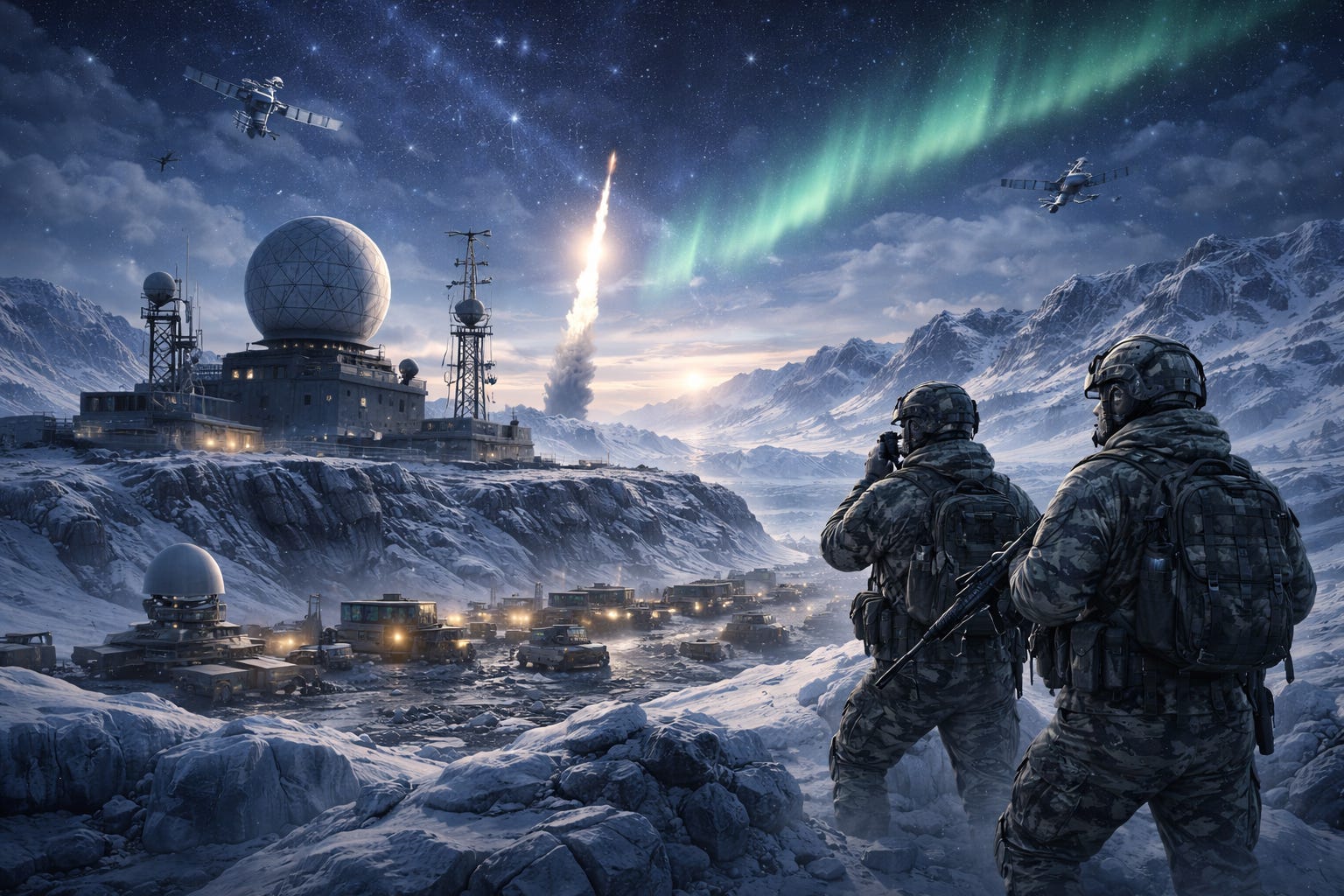
That is the opening claim. It is also, in its traditional form, largely a Cold War echo. To state it bluntly, the argument that Greenland is a necessary shield relies on 1950s tactical assumptions that no longer apply.
The missile logic changed
Modern ICBMs don’t behave like slow bombers that need geographic stepping stones. The “goalkeeper Greenland” story doesn’t fit the physics: missiles arc into the upper atmosphere and descend from space, making a conventional “fortress on the ice” far less meaningful than it was in the bomber era.
The defensive value of conventional basing is “exactly zero” against modern Intercontinental Ballistic Missile strike logic—because modern missiles “do not care about geography.”
The troop reality contradicts the rhetoric
If Greenland were the indispensable conventional fortress, you would expect a steady build-up. Instead, let’s highlight a long drawdown: from ~10,000 troops at the Cold War peak to ~150 US personnel today, concentrated at Pituffik. That number is not an accident. It’s a strategic verdict.
What remains is not “defense” in the old sense—it’s sensors and data
The military relevance that persists is narrower and more modern: warning, tracking, space domain awareness, and command-and-control—C4ISR logic (the “nervous system,” not the “muscle”). That point matters because it bridges directly into the real 21st-century stakes:
Greenland is valuable where the world becomes informational. Which leads us straight to the other drivers—the ones that hide behind the word “defense.”
The minerals story: geology becomes politics
Rare earth elements are not “rare” in the poetic sense. They are rare in the strategic sense: concentrated processing capacity, fragile supply chains, high leverage.
Greenland is a potential “strategic bank” for Western de-risking—because China controls a dominant share of processing, and that dependency becomes coercible.
But minerals come with two quiet frictions that the “security” narrative tends to skip:
Policy risk / social license
A mining project can die, not because the ore isn’t there, but because legitimacy isn’t. Uranium co-location and a legal threshold became a stopper—local opposition can break bankability.
Infrastructure deficit
Mining in Greenland isn’t just a permit. It’s ports, power, roads, and long logistics in extreme conditions.
This is where the West’s habitual weakness shows: it often sees “resource security” as a map problem, not as a governance problem.
The sea-lane story: climate change as a power multiplier
The arithmetic: Arctic corridors can shorten Asia–Europe routes, cut travel time, and save fuel—turning melting ice into economic opportunity (the “Arctic Paradox”). This creates a morally uncomfortable reality:
A planetary wound becomes a strategic advantage.
And Greenland sits close to the logic of future routes—especially if navigability expands over decades. In such a world, Greenland is not just a landmass. It is part of the architecture of movement.
The “Donroe Doctrine” story: when exclusivity returns
The “Donroe Doctrine”—a coercive reinterpretation of the Monroe Doctrine, recasting the Arctic as a U.S. “backyard,” and shifting from partnership logic to ownership logic.
If that frame becomes dominant, then Greenland is no longer treated as a society with rights. It becomes treated as a strategic bank to be acquired. And once that shift happens, the method tends to follow:
Charm, then pressure, then infiltration—a phased escalation pattern.
This isn’t only about Greenland. It is about a broader drift: strategic necessity used as a solvent that dissolves sovereignty.
The 2025–2026 crisis: Greenland as a stress test of alliance trust
The “Greenland crisis” is a modern case study in coercion and hybrid tactics, including tariff threats, “gray zone” actions, and disinformation gestures.

On the public news side, we can see how that tension has continued to reshape the landscape:
NATO has begun military planning for an “Arctic Sentry” mission amid Greenland-related tensions and Arctic security concerns.
Britain expects Arctic security plans (including Greenland) to be discussed at a NATO defence ministers meeting on Feb 12, 2026.
Canada and France are opening consulates in Nuuk—explicitly signaling support for Denmark/Greenland amid the same tensions.
Even if you ignore every political personality and headline flourish, those moves tell you one thing:
Greenland has become a live wire inside Western alliance management.
When allies start hedging inside the alliance—opening consulates, proposing new missions, talking about “enhanced vigilance”—it is a sign that something deeper than “defense” is being negotiated: trust, authority, and control.
The Arctic Cloud: why “AI-data centers” belong in the title
Now we reach the part that most commentary still treats as an afterthought.
I call it the “Arctic Cloud.” In my view, this is a fourth pillar: data infrastructure and AI readiness.
The logic is simple enough for high-school physics:
AI training and large-scale compute generate enormous heat. Cooling is a major cost.
Greenland’s climate offers “essentially infinite free cooling,” turning harshness into competitive advantage.
But the deeper point is this: data centers are not neutral warehouses. They are strategic infrastructure.
Whoever controls the ground layer—centers, cables, ground stations—controls vulnerabilities and leverage.
A concrete pattern: a Chinese attempt to build a satellite ground station was viewed as “dual-use” and was blocked—because the U.S. and Denmark treated data flows as a national security issue.
That is the bridge between “defense” and “Artificial Intelligence”:
In the 21st century, defense increasingly means control over sensing, data, compute, and connectivity.
And Greenland already hosts high-stakes infrastructure at Pituffik—as a hub for space domain awareness and satellite operations. So yes, “AI-data centers” belongs in the title, not because it is trendy, but because it is structurally consistent with how power now behaves. It also reframes what annexation talk would mean in practical terms: Not “more territory,” but more control over strategic compute—in a location that is alignable.
The hidden costs, the part maps don’t show
Whenever Greenland is discussed as a “shield,” a “bank,” or a “node,” there is a human risk: the island becomes an object rather than a subject.
Two hidden costs keep returning:
Sovereignty erosion through “strategic necessity”
When a powerful state treats an ally’s territory as a commodity, it normalizes coercive diplomacy and corrodes alliance legitimacy—a long-term rupture risk.
Local legitimacy as an afterthought
Mining, infrastructure, foreign investment, and “strategic projects” all require a social license to operate. Ignore that, and projects fail—or succeed while leaving lasting harm.
If Greenland becomes the stage for resource extraction and strategic compute, the hardest governance question is not “What can be built?” It is:
What must be protected so that Greenlanders remain authors of Greenland—rather than tenants of someone else’s strategy?
Closing: Greenland is not just ice. It is not just rock. It is not just a radar on a lonely base.
It is a test of what “security” now means. If security means the right to acquire, pressure, or rewrite sovereignty, then the word has become an excuse.
If security means building durable partnerships—treaty-based, consent-based, and economically real—then Greenland could become a model instead of a wound.
And if the new territory is compute, then the Greenland question becomes even sharper:
Will the 21st century be governed like a commons—shared rules, shared legitimacy—or like a data center—restricted access, perimeter security, and ownership logic?
The map will not answer that. People will.
Synthesis
Greenland is being reframed from “remote territory” into a strategic junction: legacy security infrastructure, mineral supply chains, opening Arctic sea lanes, and increasingly, AI-era data infrastructure. The classic “defense” rationale often functions as a 1950s-era alibi; modern relevance is narrower (sensors/data) and blends into data sovereignty and compute. The core question is legitimacy: sovereignty belongs to Greenlanders as a people, so any “purchase/ownership” logic clashes with modern law and risks deep alliance rupture. More on that to be continued.
© Robert F. Tjón, February 2026 | Creative Commons CC BY-NC-ND 4.0 International
Legend
AI — Artificial Intelligence
C4ISR — Command, Control, Communications, Computers, Intelligence, Surveillance, Reconnaissance
ICBM — Intercontinental Ballistic Missile
NATO — North Atlantic Treaty Organization
REE — Rare Earth Elements
More on American imperialism:
AI Disclosure: I use AI to help synthesize sources and map complex topics—particularly when data research is involved. While I review and edit the results, AI output can be imperfect; please verify any critical facts independently.
Sources
Reuters on NATO “Arctic Sentry” planning and the Feb 12, 2026 discussion context.
AP on Canada and France opening consulates in Nuuk; French foreign ministry statement (Feb 6, 2026).
Gauging the Gap: The Greenland–Iceland–United Kingdom Gap – A Strategic Assessment (Nick Childs, International Institute for Strategic Studies, April 2022)
Greenland Is Strategic: But It Is Not a Pawn (Sophie Arts & Penny Naas, German Marshall Fund, Jan 2026)
Greenland crisis (Wikipedia Article, accessed/dated Jan 2026)
Greenland in World War II (Wikipedia Article)
Greenland | Security, Minerals, or AI-Data Centers (The Wise Wolf / Substack Post)
Greenland’s Critical Role in North America; The US Way Ahead (Lt. Col. Ali N. Omur, Northern Command/US Army, 2020)
Greenland’s geopolitics: what does Trump seek? (Monex Analysis, Feb 2025)
Greenland’s strategic shift as a game-changer in the global rare-Earth race (EU Reporter, Dec 2025)
Greenland, Rare Earths, and Arctic Security (Meredith Schwartz & Gracelin Baskaran, CSIS, Jan 2026)
Hands off Greenland protests (Wikipedia Article, dated Jan 2026)
If Trump’s ‘framework’ Greenland agreement relies on creating ‘sovereign’ bases, it would bring long-term legal issues (Marc Weller, Chatham House, Jan 2026)
Intelligence Outlook 2025 (Danish Defence Intelligence Service)
Pituffik SB, Greenland (Official Fact Sheet, Peterson Space Force Base)
Pituffik Space Base: strengthening U.S. defense capabilities in the Arctic (The Watch, March 2025)
Project Iceworm (Wikipedia Article)
Q&A: China’s interests in Greenland (Patrik Andersson, Swedish National China Centre, Feb 2026)
The Arctic Paradox: Melting Ice And The U.S. Scramble For Greenland’s Treasures (Altaf Moti, Eurasia Review, Jan 2026)
The Case for a Reimagined NWS (Andrea Charron, NAADSN, Oct 2019)
The Strategic Importance of Greenland: The Role of Tactical Missile and Air Defense in the Arctic (Small Wars Journal, Oct 2025)
Both