
Democracy is Critical Infrastructure now (Video at the bottom)
Europe still waits for war to announce itself. Russia has found the space where it does not have to.

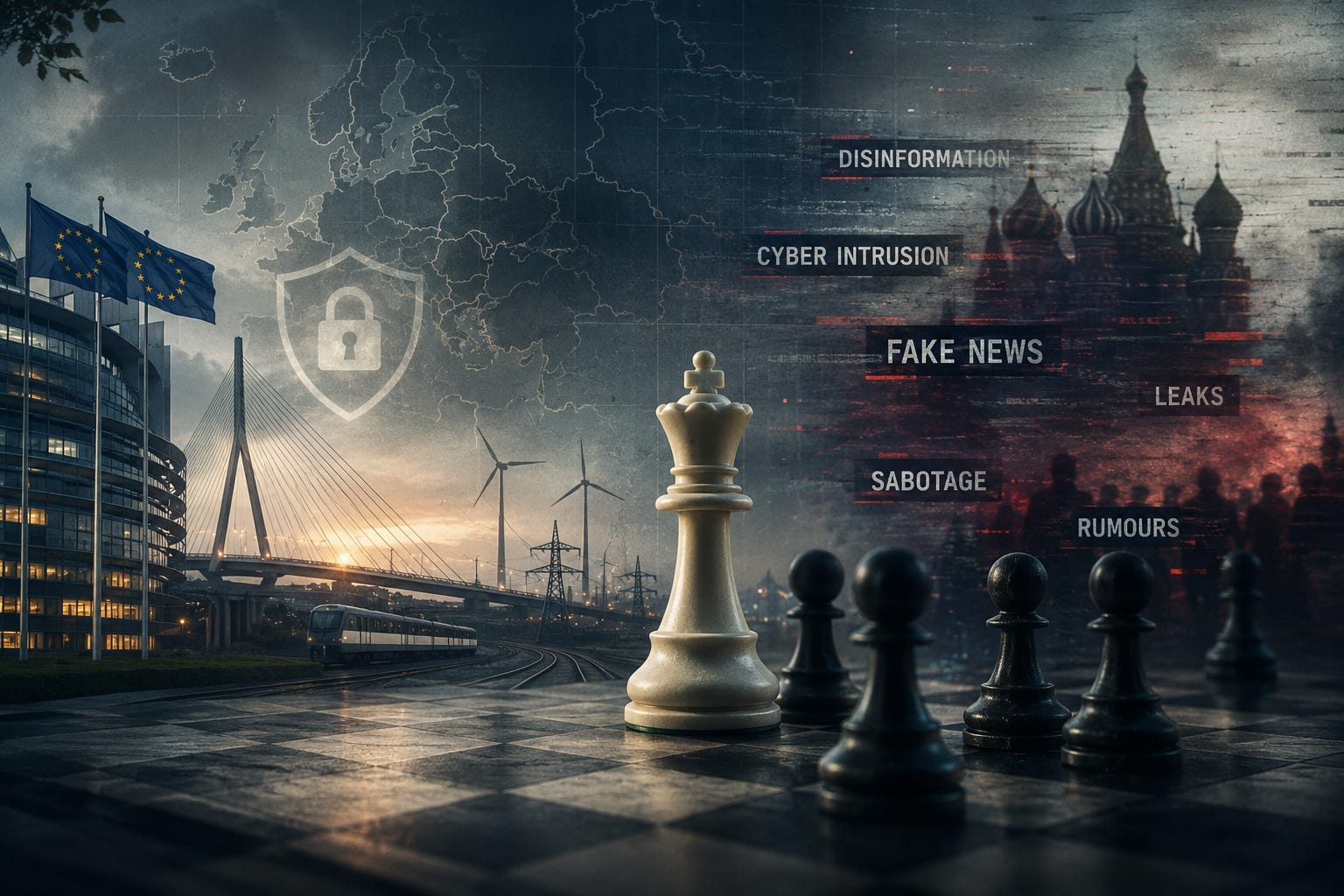
Europe still has an old reflex.
War is what happens when tanks cross a border. Peace is what exists before that moment. Between the two, we imagine diplomacy, tension, espionage perhaps — but not war.
That distinction once made sense. It helped Europe rebuild itself after catastrophe. It gave us law, treaties, alliances, courts, procedures, and the comforting belief that violence would be visible before it became decisive.
But Russia has found the space between those categories. The grey zone: not peace, not open war either. Something colder.
A cyber intrusion that can be denied. A local-looking news site that did not grow locally. A railway cable cut at the wrong moment. A leaked conversation, twisted just enough to poison trust. A drone near sensitive airspace. A rumour released when an election is already tense.
Each incident remains small enough to be argued about. The argument is part of the method. Taken together, they create pressure. Pressure, applied long enough, changes political reality.
The old European reflex
Europe’s success has also left it with a blind spot.
The continent was rebuilt around the idea that conflict could be contained by law, trade, institutions, treaties, and procedures. This was not naïve. It was one of the great achievements after 1945.
But every achievement has a shadow. Europe became very good at managing peace. It became less fluent in recognizing hostility that does not arrive in the old forms.
A missile is easy to classify. A tank column forces the language to become clear. An invasion removes ambiguity.
But what do we call a slow campaign of confusion? Sabotage that cannot be attributed immediately? The deliberate amplification of mistrust and exhaustion?
Too often, we reach for smaller words. Interference. Disinformation. Cyber activity. Incident. These words are not false. They describe the tools. They do not yet describe the strategy.
Russia’s method is not necessarily to defeat Europe in a direct military confrontation. That would be costly, risky, and uncertain. A cheaper method is to make Europe less sure of itself: less sure of its governments, its media, its elections, its alliances, its support for Ukraine, and sometimes even of the future it claims to defend.
That is why the grey zone matters. It is not a place on a map. It is the condition in which a democracy is attacked before it has agreed on the name of the attack.
The grey zone
The grey zone works because it exploits the better instincts of open societies.
Democracies hesitate before naming guilt and asks for evidence. They argue over proportionality and worry about escalation. They distinguish criticism from manipulation. Europe asks whether a response might injure the freedoms it wants to protect.
Open societies should do all that, the hesitation is not weakness; it is part of our civilization.
It becomes dangerous when the other side understands this hesitation better than we do.
A hostile actor does not need every operation to succeed. Enough noise, doubt, and delay will do. One false story is corrected, while another has already moved. One cyberattack is denied. One sabotage case is treated as isolated. A leak becomes a scandal before its context catches up.
Then the democratic system does much of the work itself. Journalists investigate. Politicians accuse each other. Citizens divide into camps. Institutions speak carefully, sometimes too carefully. Social media rewards the sharpest emotion, not the soundest judgment.
By the time the facts become clearer, the emotional damage is already done.
That is the advantage: cheap, deniable, and cumulative. Europe is kept in a state of interpretive delay. Not quite enough to respond, but never small enough to ignore.
The real target
We still speak of critical infrastructure as if it were mainly physical: ports, railways, power grids, pipelines, airports, data centres, satellites, undersea cables, hospitals, food chains, government servers.
A modern society is a fragile choreography of systems most citizens never see until they fail. Below that physical layer lies another kind of infrastructure: trust.
Not blind, not the childish belief that governments, media, or institutions are always right. Something more modest and more necessary: the minimum trust without which a society cannot function.
Trust that elections are not theatre and that facts still matter. Trust that disagreement is not treason and imperfect institutions are not automatically illegitimate. Trust that a political opponent is not necessarily an enemy of the people. Trust that reality exists outside the emotional machinery of the feed.
This is the layer being tested.
Russia did not invent Europe’s distrust. Europe has enough of its own failures, arrogance, bureaucracy, inequality, hypocrisy, and political blindness. No foreign power is needed to explain why citizens sometimes lose faith.
But external pressure can find the crack and widen it. That is the essence of hybrid conflict. It studies the weakness, feeds it, amplifies it, and waits for the target society to turn against itself.
A lie is not always meant to be believed, but it may be enough to make truth feel unreachable. A rumour is not always meant to persuade; it only needs to make people tired. A scandal is not always meant to reveal; sometimes it is enough that public life or politics begins to look dirty.
The target is therefore not only what Europe has; it is what Europe still believes about itself.
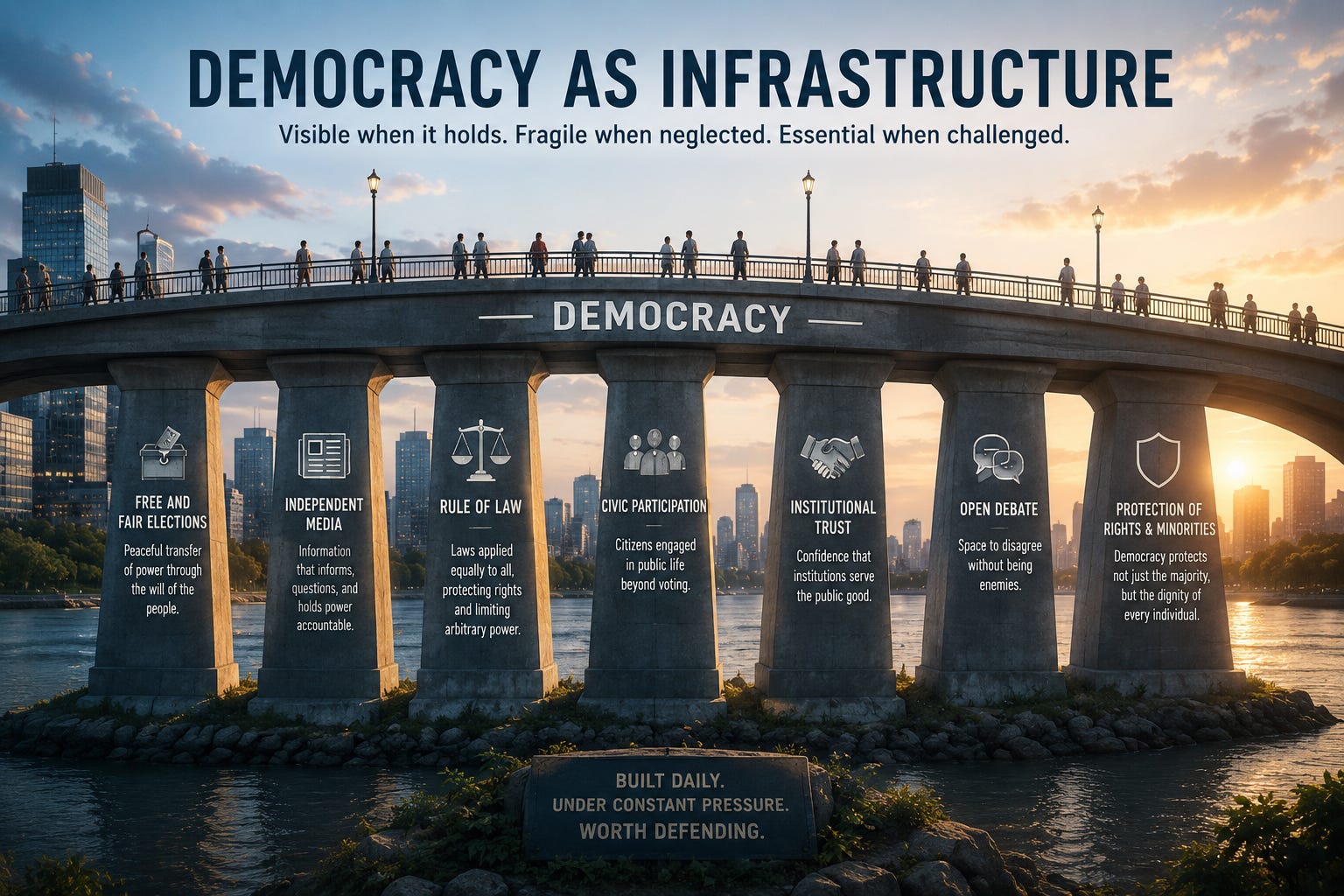
This is why democracy itself has become critical infrastructure. I do not mean that as a slogan. From a practical point of view:
If a railway line is damaged, goods cannot be transported. When a power grid is disrupted, homes and factories cease operations. When a hospital system is attacked, lives are endangered. If public trust erodes, democratic decisions lose their legitimacy and the political centre slowly melts.
A democracy cannot survive only on rules. It also needs habits: checking before sharing, tolerating uncertainty, accepting electoral defeat, listening without surrendering judgment, and asking who benefits when anger becomes too perfectly targeted.
These habits do not look like defence policy. But they are part of defence now.
That is uncomfortable because we would prefer European defence to be about armies, intelligence services, cyber agencies, and ministers. They have their part, a large one, and certainly a larger one than now. But they cannot protect the civic nervous system alone.
Citizens are no longer outside the security perimeter.
This does not mean every citizen must become suspicious or obedient. Quite the opposite. A frightened society is easy to manipulate, and a cynical society is easy to exhaust. When we see enemies everywhere, we may damage ourselves more efficiently than any foreign power could.
The task is harder: to stay open without being naïve, critical without becoming corrosive, free without being defenceless.
The danger of overreaction
There is a trap here.
Once we say that democracy is under attack, some will be tempted to treat dissent itself as suspicious. That would be a mistake. A dangerous one.
Not every anti-NATO voice is a Russian asset. Not every criticism of Ukraine policy is propaganda. Not every angry citizen has been manipulated. Not every unpopular question is subversion.
A democracy that forgets this begins to defend itself by narrowing itself. The media may mirror that, perhaps even enforce it. That would be another form of defeat.
The solution to manipulation cannot be a fragile public discourse that only tolerates approved opinions. The answer to disinformation cannot be to infantilize citizens or resort to outright lies. The solution to foreign interference cannot be to prioritize secrecy whenever honesty would be challenging.
If trust is infrastructure, governments also have obligations. They must speak clearly, have the courage to admit uncertainty when it exists, avoid exaggeration, and resist the temptation to use security language as a shield against political accountability. Above all, they must earn enough trust to ask for vigilance. Without trust, citizens feel offended and turn to extremists.
Citizens are not stupid; they know when language is being managed. People feel when institutions speak more to protect themselves than to inform the public.
And that, too, creates openings for hostile actors.
The defence of democracy begins at home. Not in the sentimental sense. In the practical sense.
A state that wants citizens to resist manipulation must not manipulate them itself.
The sober answer
So what does resilience look like?
Not panic, and not permanent emergency. Not the militarization of public life. Not a Europe where every uncomfortable opinion is scanned for foreign fingerprints. Resilience is quieter than that.
It is the discipline of naming hostile acts when the evidence is strong, protecting infrastructure before disaster makes it fashionable, teaching critical media literacy without naivety or condescension, building cyber defence without theatre, and practising political leadership that does not feed the same mistrust it claims to fight. It also means learning, as citizens, to pause before passing on the emotional spark.
Resilience is sober adulthood.
Europe has sometimes behaved as if peace were a natural condition, interrupted only by war. But peace is not a default setting; it is a structure. It needs maintenance and memory. It requires institutions that still deserve confidence and citizens who do not confuse freedom with carelessness.
Russia’s grey-zone pressure forces Europe to rediscover this. Not because Russia is all-powerful, but because the battlefield has widened.
Some of it is still military. Some of it is cyber. Some of it runs through ports, cables, satellites, and energy systems. But some of it runs through the ordinary mind of the citizen: what we believe, what we doubt, what we forward, what we forgive, what we stop caring about.
That is the uncomfortable part.
Europe still waits for war to look like war. Russia has learned to arrive otherwise.
If democracy is now critical infrastructure, then defending it cannot mean simply guarding buildings, servers, and borders. It must also mean repairing the common space in which citizens decide what is real, what is worth defending, and what kind of society they refuse to become.
Not perfect. Not innocent. Not always wise. But still worth defending.
Note
This essay is not about panic. It is about the uncomfortable fact that modern pressure on Europe often happens below the threshold of open war. The target is no longer only territory or infrastructure. It is democratic confidence itself.
©️ Robert F. Tjón, May 2026
Facts & Sources:
https://docs.google.com/document/d/14gEuTyaFDOLE-ivk4QfuL9op0gteOU1V/edit?usp=sharing&ouid=107527150241003063462&rtpof=true&sd=true
The Video:
AI Disclosure: My work utilizes artificial intelligence for data synthesis and structural mapping. Please note that AI-generated insights may occasionally contain inaccuracies; readers are encouraged to verify critical information. All conclusions and final editorial decisions remain the original work of Robert F. Tjón. Content is subject to the ©️ CC BY-NC-ND 4.0 INTERNATIONAL license.